Industrial Automation Integrating Hyperspectral Cameras
Traditional industrial machine vision can only capture appearance color and contours, making it difficult to identify material composition, internal micro-defects, and subtle quality differences. Hyperspectral cameras, with their exclusive spectral fingerprint recognition capability, integrate deeply with automated production line control systems and are widely used in scenarios such as plastic recycling sorting, automotive paint quality inspection, electronic component testing, and textile dyeing management. This article explains the technical principles, integration solutions, solutions to common application challenges, and equipment selection key points, along with practical case references.
I. Pain Points in Smart Manufacturing Transformation: Limitations of Traditional Visual Inspection
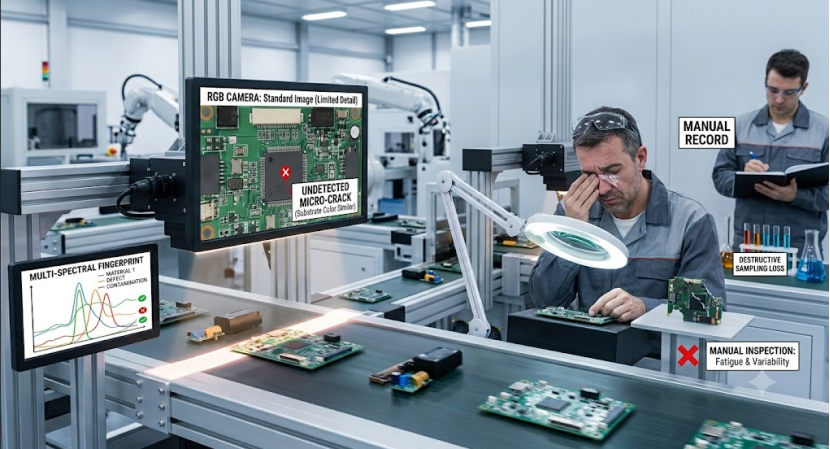
In modern automated production lines, visual inspection is a core step in quality control and material sorting. However, conventional color industrial cameras and single-point spectral sensors have long-standing limitations:
1. Limited resolution: Materials with highly similar appearances cannot be distinguished—for example, PET, PVC, and PP plastics look almost identical to the naked eye and on normal imaging, leading to high manual sorting error rates and low efficiency; black plastics, due to their light absorption properties, cannot be identified with conventional optical devices.
2. Narrow inspection dimensions: Only surface morphology can be captured. Micro hidden defects like coating thickness, internal microcracks, cold solder joints, and uneven additive distribution cannot be detected and rely on sampling, leading to high miss rates.
3. Difficult adaptation to high-speed production lines: Single-point sampling covers limited areas. On fast-moving conveyor belts, inspection blind spots easily occur, making full-surface, continuous online inspection impossible.
4. Data cannot be traced or quantified: Inspection results rely on human visual judgment, with no standardized spectral data recorded, making process optimization and quality traceability lack precise evidence.
With production lines speeding up, quality control standards upgrading, and the expansion of material recycling needs in the circular economy, industrial scenarios urgently need new vision solutions that can achieve chemical-level non-destructive identification, high-speed online acquisition, and digital data retention. Hyperspectral imaging technology has thus become a key driver for industrial automation upgrades.
II. Hyperspectral Cameras Empowering Industrial Automation: Core Principles and Integration Logic
1. Basic Imaging Principles
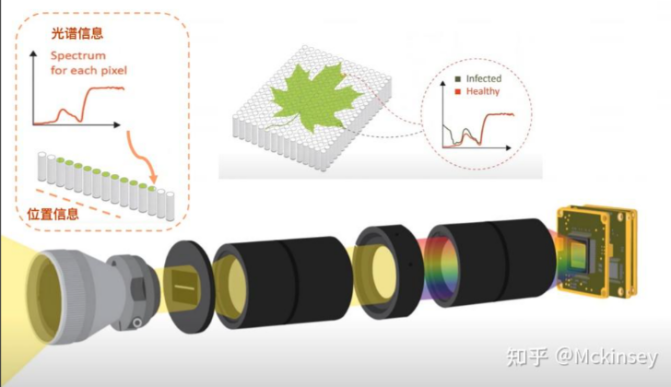
The key difference between hyperspectral cameras and ordinary cameras is their ability to split light ranging from visible to near-infrared and short-wave infrared into hundreds of continuous, fine bands. Each pixel in the image can generate a dedicated spectral curve, essentially a material's unique spectral fingerprint. Different materials, compositions, and defect structures create distinct spectral absorption peaks. By comparing these with a spectral database, the system can instantly identify materials, detect defects, and measure compositions.
2. Complete Integration with Industrial Automation Systems
The full system is made up of five modules connected in sequence, seamlessly integrating with existing assembly line PLC control systems:
1. Imaging Acquisition Unit: Line-scan hyperspectral camera (industrial mainstream choice), scanning at a consistent speed along the conveyor belt, suitable for detecting continuously moving materials.
2. Standardized Lighting Module: Diffuse coaxial light source that avoids interference from workshop dust and light fluctuations, ensuring stable spectral acquisition.
3. Edge Computing Terminal: Built-in spectral algorithms and AI classification models provide real-time analysis on-site without needing to transmit data to a backend server, delivering judgment results in milliseconds.
4. Automated Actuators: Sorting valves, robotic arms, and rejection devices accurately complete the sorting of good products and removal of defective ones based on inspection signals.
5. Data Storage and Management System: Collects full-time spectral detection data for process iteration, quality traceability, and report generation.
The entire integration solution offers non-contact detection, avoiding damage to workpiece surfaces, requires no chemical reagents, and can adapt to complex industrial environments such as clean rooms, dusty areas, and high/low-temperature workshops.
III. Four Main Industrial Automation Applications of Hyperspectral Cameras
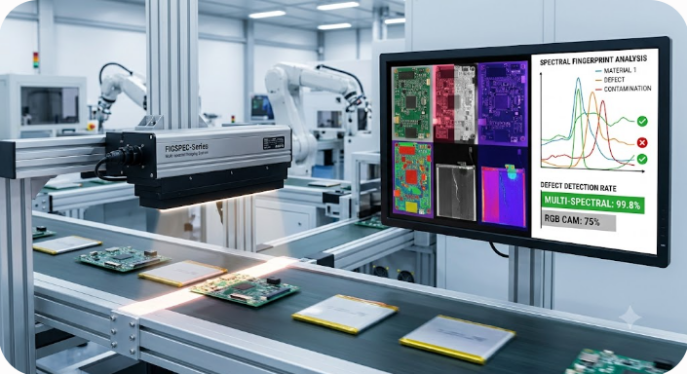
Scenario 1: Automated Sorting of Recyclable Resources (Plastic and Metal Recycling)
Plastic recycling is the most mature industrial application for hyperspectral technology. Different polymer materials that look the same are sorted with less than 75% purity using traditional equipment, and mixing with other plastics directly affects the quality of recycled materials. Hyperspectral cameras, using short-wave infrared spectral features, can clearly distinguish more than a dozen types of plastics like PE, PP, PET, ABS, PVC, PS, and even black plastics, which are traditionally difficult to sort. Paired with automated conveyors and air-jet removal systems, sorting capacity can reach 600-700 kg per hour, and material purity can stably exceed 98%. In colored metal sorting, hyperspectral cameras can quickly differentiate copper, aluminum, iron, and stainless steel, significantly reducing manual sorting costs and improving resource recycling efficiency.
Scenario 2: Online Quality Inspection in Precision Manufacturing (Automotive, Electronics, Semiconductor)
1. Automotive industry: Inspecting paint coating uniformity, paint thickness (accuracy up to ±0.1μm), bubbles, and fine scratches; identifying insulation material differences in wiring harnesses and coating defects in connectors, replacing traditional X-ray inspection with no radiation risk and lower maintenance costs;
2. Electronic PCB components: Detecting soldering defects like cold joints, oxidation, and bridging, analyzing composition distribution in soldered areas, with full-board scanning speed up to 2000 boards per hour for 100% factory inspection;
3. Film and new material production: Full-width, high-speed monitoring of plastic films and optical films on production lines to detect pinholes, impurities, uneven thickness, and composition shifts in real time, avoiding batch defects.
Scenario 3: Textile Dyeing and Color Control
Color differences and uneven dye distribution have long been challenging in the textile industry. Hyperspectral imaging quantitatively captures subtle color differences, dye penetration variations, and fiber blend ratios, unlike subjective human visual assessment. It can also detect tiny fabric defects or holes online and simultaneously monitor the stability of finishing processes, ensuring consistent dyed products and reducing rework due to color deviations.
Scenario 4: Automated Quality Screening in Food and Pharmaceuticals
On food production lines, it allows non-destructive testing of sugar, moisture, and fat content, and can detect mold or contaminant residues. In pharmaceuticals, it checks for uniformity of components in pills, foil-seal integrity, and cracks, all without contact, preserving packaging integrity and meeting strict clean production standards in the medical industry.
IV. Key Considerations for Selecting Industrial Hyperspectral Cameras: Meeting Automation Integration Needs
The selection criteria for industrial production lines are very different from those for lab research equipment. Priority should be given to five main aspects: imaging speed, environmental tolerance, interface compatibility, spectral range, and ease of secondary development:
1. Imaging Speed: High-speed production lines need line-scan models with ROI acceleration, as typical frame rates cannot keep up with conveyor belts;
2. Spectral Range: Visible light (400-700nm) is suitable for color and surface defect detection; Near-infrared (900-1700nm) is often used for sorting plastics and food; Shortwave infrared (1000-2500nm) works for black plastics and deep material analysis;
3. Hardware Protection: IP65 dustproof and waterproof body to withstand workshop vibration, temperature fluctuations, and dust;
4. Communication Interfaces: Standard GigE Vision industrial interfaces that can directly connect to PLCs and machine vision software, greatly shortening integration time.
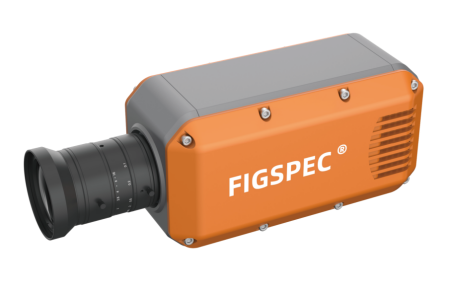
Among many hyperspectral imaging devices designed for industrial automation, the FigSpec series has been deeply optimized for online inspection on production lines. The FS-1X line-scan hyperspectral camera is specifically made for continuous industrial lines, using a transmissive grating spectrograph architecture, with excellent spectral resolution and a regular mode imaging speed above 100 Hz. When the ROI mode is activated, the frame rate can be significantly increased, easily matching high-speed conveyor operations.
Its spectral bands cover the full range from visible light to shortwave infrared, and manufacturers can customize ranges based on different applications like plastic sorting, electronics inspection, or film testing. The camera comes with a standard C-mount, compatible with various industrial lenses, and includes a complete SDK for easy secondary development, allowing system integrators to quickly embed it into existing automated production lines. The device is rigorously calibrated for industrial conditions, providing stable signal-to-noise performance. Even in complex workshop lighting, it still outputs smooth and precise spectral curves, ensuring accurate material identification and defect detection.
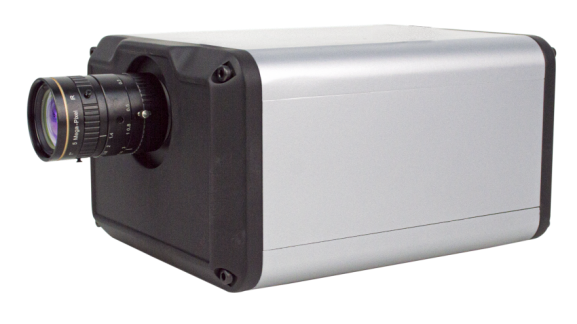
Additionally, the FS2X area-scan series is suitable for offline sample inspections and lab R&D testing. It can capture micron-level defects, serving both production line quality checks and new product formulation research, covering the full spectrum workflow from early R&D and pilot testing to mass production online monitoring. Drawing on years of optical R&D experience, the devices balance stable performance with practical cost-effectiveness, and come with localized technical support and after-sales service, effectively solving common industry issues like long integration and calibration times or poor adaptation to working conditions.
V. Common Challenges and Solutions for Automation Integration
1. Challenge 1: Blurry images and jittery spectral data on high-speed production lines
Solution: Choose line-scan models with ROI frame rate acceleration, paired with a synchronized encoder so the camera scanning rhythm matches the conveyor speed precisely, eliminating motion blur. Built-in noise reduction algorithms optimize spectral data stability under complex conditions.
2. Challenge 2: High barrier to building spectral models, lack of professional spectral personnel in the company
Solution: Use visual spectral modeling software; no deep spectral expertise is needed. Simply import standard samples for quick training of material classification and defect detection models, and deploy to edge devices with one click.
3. Challenge 3: Limited space for modifying existing production lines, hard to install equipment
Solution: Compact body design that is small and can be ceiling- or side-mounted above the production line, requiring minimal changes to the existing automation setup, reducing renovation costs.
4. Challenge 4: Long-term data drift requiring frequent calibration
Solution: Factory-wide unified spectral calibration, data interchangeable across same-model devices, with a standardized calibration whiteboard for simple on-site periodic calibration, making maintenance easy.
VI. Summary of Application Value: Benefits of Industrial Automation Upgrades
1. Efficiency improvement: Completely eliminate manual visual inspection, boosting line inspection efficiency by 3-8 times, with significant increases in sorting and quality control capacity.
2. Quality optimization: Detection rate for defects and foreign materials exceeds 99.9%, significantly reducing defective products and rework losses.
3. Cost reduction: Save long-term labor inspection costs and defective product losses; equipment investment can be recouped in 1-2 production cycles.
4. Digital upgrade: Complete retention of spectral inspection data supports iterative production processes and full-chain quality traceability, aiding the building of a digital factory system.
VII. Industry Development Trends
With the miniaturization of optical devices and continuous iteration of AI spectral algorithms, the hardware cost of hyperspectral cameras is steadily decreasing, and integration difficulty is continually reducing. These cameras are gradually spreading from high-end precision manufacturing to small and medium-sized factory production lines. In the future, hyperspectral imaging will deeply integrate with industrial robots and digital twin systems, using massive spectral data to autonomously optimize production processes, becoming a core part of intelligent manufacturing visual perception systems.


