What is a Hyperspectral Camera and How Does It Work?
Have you ever wondered if you could 'see through' an object's chemical composition just by taking a photo?
Unlike traditional color cameras that can only capture red, green, and blue (RGB), hyperspectral cameras break through the limits of human vision. They can split light waves into dozens or even thousands of continuous narrow bands, which not only precisely record the external appearance of objects but also capture the unique 'spectral fingerprint' of materials. This allows you to identify an object’s chemical composition and internal structure without damaging it.
With the rapid development of spectral imaging technology, hyperspectral cameras have moved from the lab to wider practical applications. This article will dive into the core principles and acquisition modes of hyperspectral cameras and introduce the FigSpec hyperspectral imaging solution, which has shown outstanding performance in industrial quality inspection and scientific research.
I. What is a Hyperspectral Camera?
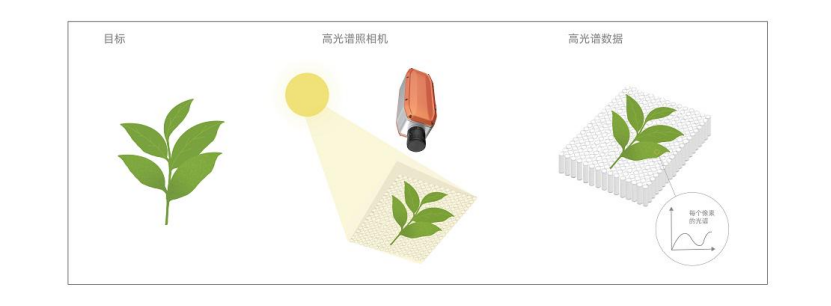
Simply put, a hyperspectral camera is an advanced optical detection device that combines image information (spatial dimensions X, Y) with spectral information (spectral dimension λ).
RGB Camera: Only captures 3 broad bands (red, green, blue). It can only tell you, 'This is an apple, and it’s red.'
Multispectral Camera: Captures 3 to 20 specific discrete bands. It can tell you, 'This apple's surface might have some defects.'
Hyperspectral Camera: Captures dozens to thousands of continuous narrow bands across a continuous spectral range (e.g., 400nm-1000nm or 900nm-1700nm). It can not only see defects but also accurately measure 'the apple's sugar content, moisture distribution, and early internal hidden diseases.'
The final data captured by a hyperspectral camera is called a Hyperspectral Data Cube. Each pixel in the data cube corresponds to a complete, unique spectral reflectance or absorption curve.
II. How Does a Hyperspectral Camera Work?
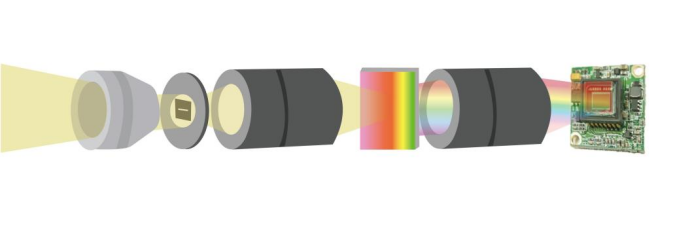
The working process of a hyperspectral camera is mainly divided into three steps: light collection and dispersion, sensor detection, and constructing the data cube.
1. Light Dispersion
When natural or artificial light shines on an object, the object reflects or absorbs certain wavelengths based on its molecular structure. A hyperspectral camera collects the reflected light through its lens and uses dispersive elements like transmission gratings, reflection gratings, or prisms to precisely spread the mixed light by wavelength (like splitting a rainbow).
2. Optical Sensor Detection
The dispersed light hits a high-sensitivity image sensor:
- Visible/Near-Infrared (VNIR, 400–1000nm): Usually uses high-frame-rate CMOS detectors.
- Short-Wave Infrared (SWIR, 900–1700nm): Uses specialized indium gallium arsenide (InGaAs) chips to detect deeper chemical components.
3. Building the 3D Data Cube
Depending on the acquisition method, the hyperspectral camera merges spatial coordinates (X, Y) with wavelength data (λ) to create a 3D data cube packed with extremely rich information.
III. Three Main Data Acquisition Modes of Hyperspectral Cameras
Depending on the hardware structure and application scenarios, hyperspectral cameras are mainly divided into the following data acquisition modes:
| Acquisition Mode | Working Principle | Advantages | Typical Application Scenarios |
| Pushbroom (Line Scanning) | Captures one row of spatial pixels (X-axis) and its corresponding full spectrum (λ-axis) each time. Images are accumulated via relative movement between the object and the camera. | Fast imaging speed, extremely high spectral resolution | Industrial inline sorting, UAV airborne remote sensing, laboratory rail inspection |
| Snapshot / Real-time Imaging | Directly acquires 2D spatial images and partial spectral dimension data within a single exposure period. | No mechanical movement required; capable of capturing dynamic targets | Medical surgical guidance, observation of dynamic biological samples |
| Built-in Scan / Rapid Inspection Scan | Integrated micro-motor scanning optical path; automatically generates images without external mechanical rails. | Extremely easy operation, suitable for rapid field inspection | Field crop analysis on farmland, sampling inspection in production workshops |
IV. Key Application Areas of Hyperspectral Technology
Since hyperspectral imaging perfectly combines both 'image structure' and 'chemical composition' information, it has brought disruptive changes to multiple industries:
Precision Agriculture and Forestry Monitoring: Detect crop diseases, pests, nitrogen deficiency, and water stress a few days before they are visible to the naked eye.
Industrial Sorting and Quality Control: Quickly sort different types of plastics on recycling lines, detect surface defects on displays, and ensure color consistency in textiles and printed materials.
Food Safety and Pharmaceutical Testing: Non-destructively measure the moisture and sugar content of fruits, detect foreign objects in food, and accurately analyze the composition distribution of tablets.
Environmental and Water Quality Monitoring: Assess water quality parameters of rivers and lakes, monitor algal blooms, and track the health status of forest ecosystems.
V. Cutting-Edge Equipment Spotlight: CHNSpec / FigSpec's High-Precision Spectral Solutions
After learning about the principles and applications of hyperspectral cameras, buyers often face the pain points of "high-end equipment being expensive, and cheap equipment having exaggerated specs." As a professional brand that has been deeply involved in spectral imaging for many years, CHNSpec (FigSpec) has become a popular choice for research institutions and industrial clients thanks to its excellent spectral resolution, ultra-fast acquisition rates, and highly competitive cost-performance ratio.
1. Line-Scan and Portable Hyperspectral Cameras (FS-1X and FigSpec-IQ Series):
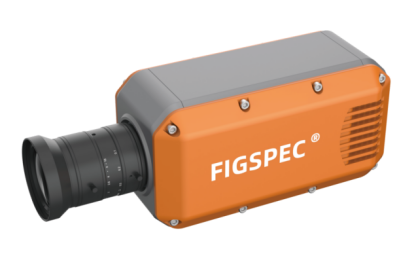
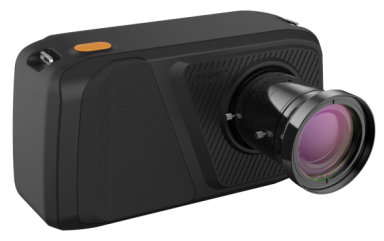
Designed specifically for industrial online inspection and field research, suitable for industrial online inspection and mobile field research scenarios, widely used for industrial color and texture measurement, fruit and vegetable grading, and online pharmaceutical sorting:
- Comprehensive band coverage: Covers multiple bands including visible light (400-700nm), visible to near-infrared (400-1000nm), and short-wave infrared (900-1700nm).
- High frame rate and excellent resolution: Spectral resolution reaches up to 2.5nm, and when using the Region of Interest (ROI) mode, full-band acquisition frequency can reach up to 3300Hz, easily keeping up with real-time inspection needs on high-speed industrial production lines.
- Outstanding cost performance: Compared to traditional equipment costing hundreds of thousands of yuan with similar configurations, it greatly lowers the barrier to equipment acquisition and upgrades.
2. Integrated Snapshot Portable Cameras (FigSpec FS2X Series):
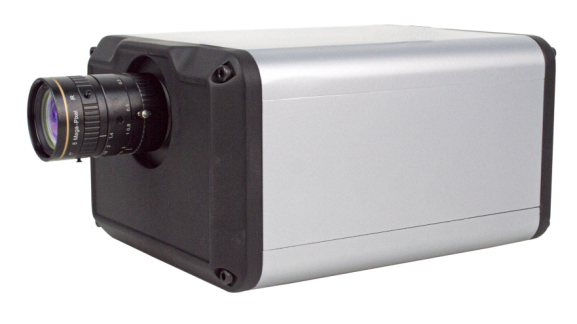
For scenarios where you need to take the experiment out of the lab and capture images in greenhouses or workshop sites, the FigSpec FS2X series offers a highly integrated all-in-one solution:
- Track-free operation: Built-in scanning mechanism with an auxiliary viewfinder camera, no need for complex external mechanical rails—just place it on a tripod and quickly capture spectral data with one click.
- Exceptional clarity: Ultra-high spatial resolution, up to 4096*4096 spatial pixels, enabling accurate inversion of soil physicochemical properties, early detection of crop pests and diseases, and more.
3. Drone-Mounted Hyperspectral Integrated System (FS60-C and FS60-UCR Series):
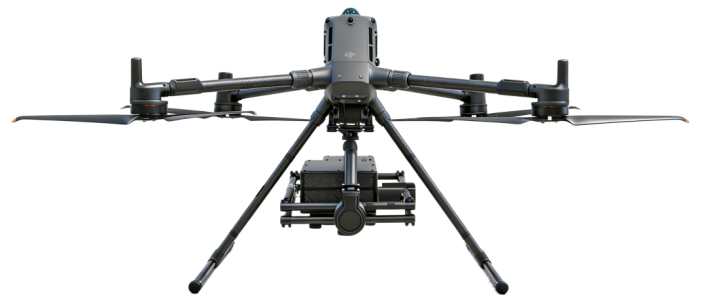
In large-scale remote sensing fields such as forestry resource patrols and ecological environment monitoring, the CHNSpec FS60-UCR deeply integrates hyperspectral cameras with multi-threaded LiDAR and high-precision POS navigation systems. Compatible with mainstream drone platforms, it can simultaneously capture high-definition 3D point clouds and spectral data in a single flight, efficiently completing large-area terrain mapping, detailed forestry surveys, and agricultural growth monitoring.
VI. Summary
Hyperspectral cameras are redefining the way we observe and understand the physical world. By relying on precise spectral separation technology to capture the unique spectral reflection characteristics of materials, they transform optical signals into quantifiable data for analysis, enabling non-destructive identification of sample physicochemical information. Currently, this technology is widely applied in various scenarios such as fresh produce quality screening, chemical composition detection, and large-scale surface remote sensing, continuously expanding the limits of optical non-destructive testing.
With ongoing breakthroughs in sensor integration and algorithm optimization by companies like CHNSpec Technology, hyperspectral imaging technology is becoming increasingly lightweight, efficient, and widespread.


