A Review of 5 Core Software Tools for Hyperspectral Data Analysis
Hyperspectral imaging technology can not only “see” the spatial shape of an object but also “read” its internal chemical composition. This combined characteristic of imaging and spectral information makes it shine in fields like agricultural monitoring, food safety, biomedicine, and industrial sorting.
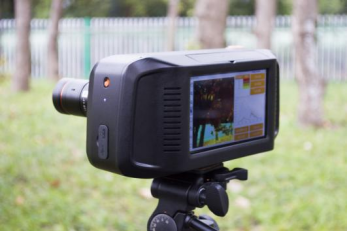
However, the data collected by hyperspectral devices is usually a massive “data cube,” containing incredibly rich spatial and spectral information. Turning this huge amount of data into intuitive analysis results requires professional and efficient software tools. Today, let's take an in-depth look at the five most popular and widely used core hyperspectral data analysis software and tools, helping you quickly find the solution that best fits your project needs.
I. Industry Classic Benchmark: ENVI
ENVI (Environment for Visualizing Images) is a professional image processing software highly regarded in the remote sensing and hyperspectral fields. With solid technical foundations, it has become a standard tool for many research institutions and universities conducting hyperspectral image analysis.
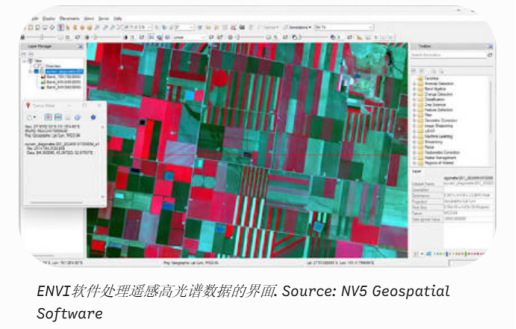
Core Advantages: Comes with a rich built-in spectral library (e.g., minerals, vegetation), supports powerful atmospheric correction models and precise spectral unmixing algorithms. Its robust "Target Detection" feature can quickly identify specific materials in complex backgrounds.
Applicable Scenarios: Aerospace remote sensing, geological and mineral exploration, large-scale forestry, and water environment monitoring.
Learning Curve: High. With such extensive functionality, beginners need structured learning and training to master the full workflow.
II. Efficient Hardware-Software Integrated Choice: CHNSpec FigSpec Studio
For many industrial applications and researchers without a computer science background, underlying code and complicated parameter settings are often hurdles for project progress. FigSpec Studio, a hyperspectral analysis software from the well-known optical inspection brand CHNSpec, stands out with its "user-focused, experience-oriented" design philosophy.
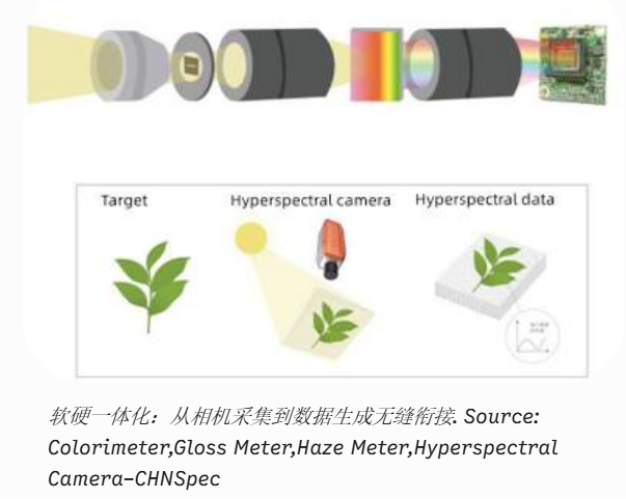
Core Advantages:
Seamless Integration: The software is deeply linked with CHNSpec hyperspectral cameras, enabling a "one-stop" workflow from data collection, real-time preview, and radiometric calibration to model analysis, completely eliminating hardware-software compatibility issues.
No-Code AI Modeling: Built-in with various mainstream machine learning and deep learning algorithms (such as Random Forest, Support Vector Machine, etc.). Users just select sample regions (ROI) through a graphical interface, and the software automatically trains classification or regression models, greatly lowering the barrier to hyperspectral analysis.
Real-Time Visualization: Supports multiple false-color composites and interactive spectral curve extraction. Particularly useful in production-line sorting and on-site rapid testing, providing immediate "what you see is what you get" feedback.
Applicable Scenarios: Non-destructive testing of agricultural products, food impurity sorting, pharmaceutical quality assessment, and material analysis—essentially any scenario requiring rapid deployment and high efficiency.
Learning Curve: Low. Offers full Chinese/English interfaces with clear, intuitive operation logic, ideal for hands-on teams focused on efficiency.
III. The Testing Ground for Algorithm Development: MATLAB
MATLAB has always been an "evergreen" in engineering computations and algorithm verification. With the continuous updates of its Hyperspectral Imaging Toolbox, it still holds a solid position in hyperspectral data processing.
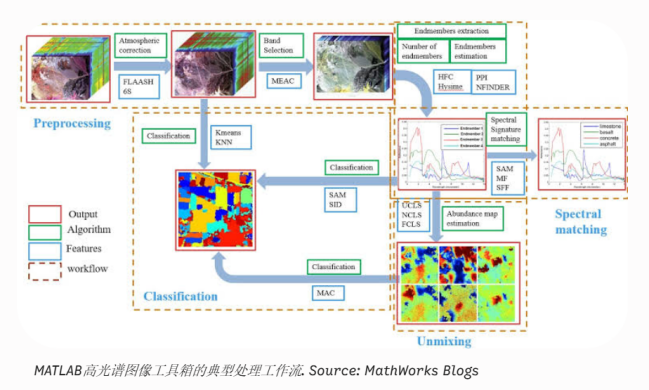
Core Advantages: Unmatched matrix computation capability. Whether it's dimensionality reduction (PCA, MNF), endmember extraction (PPI, N-FINDR), or spectral matching, researchers can either directly call mature functions or write brand-new mathematical models from scratch for validation.
Applicable Scenarios: Developing basic hyperspectral algorithms, data processing and visualization for academic papers, building complex mathematical models.
Learning Curve: Medium to high. Users need a solid programming foundation and strong mathematical modeling skills.
IV. Embracing the Open-Source Deep Learning Ecosystem: Python (Spectral / Scikit-learn)
For the current hot AI and deep learning field, the Python ecosystem is the most vibrant and flexible toolset for handling hyperspectral data. Using Spectral Python (SPy) to process data cubes, combined with Scikit-learn or PyTorch to build predictive models, is the top choice for countless data scientists.
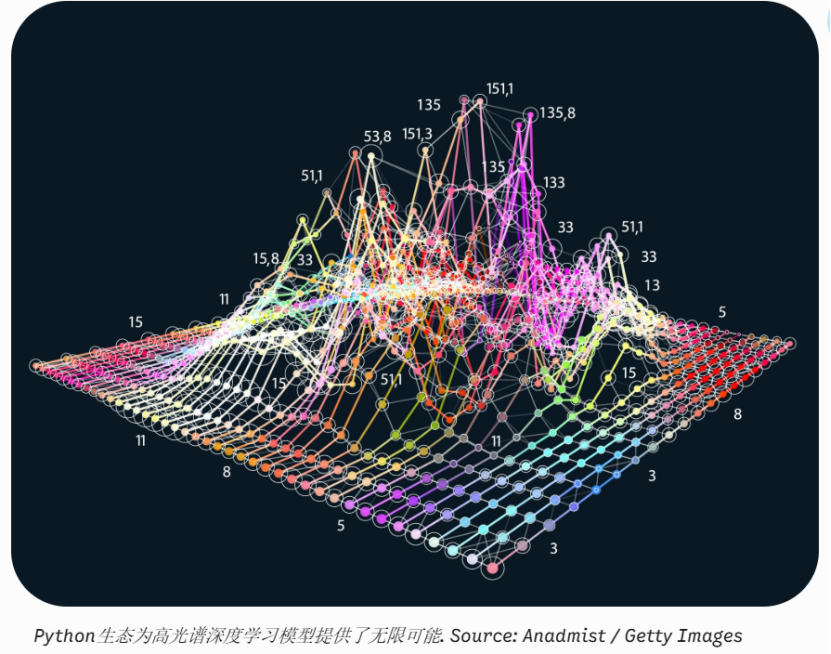
Core Advantages: Extremely high extensibility and completely free open-source licensing. It can easily integrate the latest computer vision and deep learning cutting-edge algorithms (like 3D-CNN, Transformer). By scripting, you can create highly customized automated pipelines for bulk data processing.
Applicable Scenarios: Researching cutting-edge AI algorithms, batch cleaning of large datasets, highly customized automated hyperspectral analysis workflows.
Learning Curve: High. There’s no unified graphical interface, requiring strong programming skills and experience handling environment variables and library dependencies.
V. Industrial-Grade Visual Modeling Tool: perClass Mira
perClass Mira is a commercial software focused on simplifying the machine learning process for hyperspectral data. Its biggest selling point is the deep 'black-box' and visual encapsulation of complex classification algorithms.
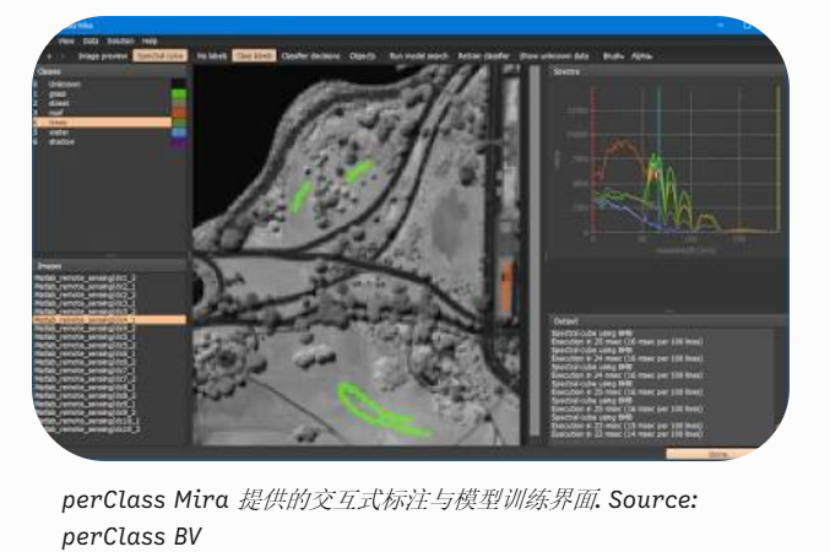
Core Advantage: It offers a super smooth graphical user interface, focusing on image classification and object recognition. Users can label data simply by 'painting,' and the software quickly computes and generates prediction models in the background. The generated models can be directly exported and deployed in real-time on production lines.
Use Cases: Industrial assembly line machine vision, waste sorting, precision agriculture for pest and disease identification.
Ease of Use: Low. It also emphasizes no-code modeling, but the commercial licensing fees are relatively high.
VI. Summary: How to Choose the Tool Best Suited for You?
Different project needs determine different tool selections:
If you lean towards macro remote sensing and mapping, ENVI is undoubtedly the classic first choice.
If you're keen on underlying algorithm research and building deep learning networks, the MATLAB and Python ecosystems are the best partners.
If you need to quickly apply hyperspectral technology to real detection projects and want to avoid tedious coding and hardware-software debugging, then an integrated hardware-software solution like CHNSpec, with its extremely low learning curve and efficient model generation capability, will save you a lot of time and R&D costs. It's a breakthrough choice that balances professionalism and ease of use.


