Hyperspectral Imaging vs. Multispectral Imaging
In fields like optical inspection, remote sensing in agriculture and forestry, food safety, industrial sorting, and material identification, spectral imaging technology is playing an increasingly critical role. Traditional cameras can only capture visual information in the red, green, and blue (RGB) channels, while spectral imaging can perfectly combine the wavelength dimension of light with the spatial image of an object, achieving a 'fusion of image and spectrum.'
In practical selection and research, hyperspectral imaging (HSI) and multispectral imaging (MSI) are the two main technologies most often mentioned and compared. This article will take an in-depth look from four perspectives: basic principles, core differences, application scenarios, and selection suggestions, helping you accurately choose the optical solution that best meets your needs.
I. What are Multispectral Imaging (MSI) and Hyperspectral Imaging (HSI)?
1. Multispectral Imaging (MSI)
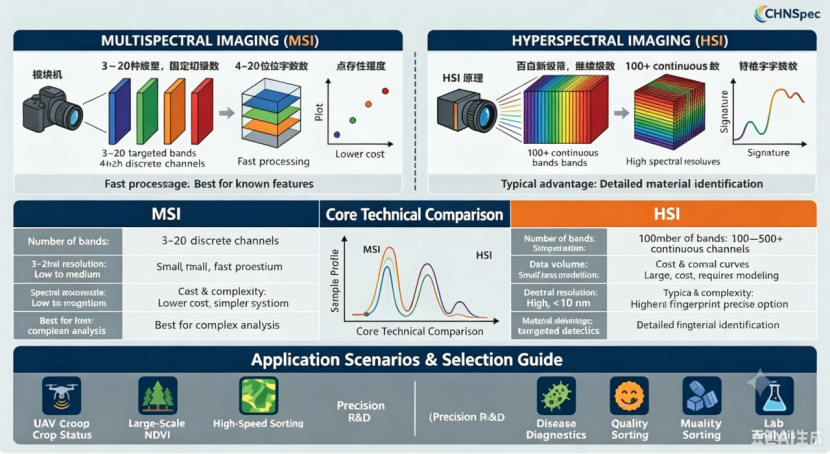
Multispectral imaging usually refers to capturing spatial and spectral information of an object over a few to dozens of specific, non-continuous bands. It has fewer spectral channels, and gaps often exist between bands (non-continuous).
Spectral channels: generally around 3 to 20.
Bandwidth: relatively wide (usually 20–50 nm or more).
Capture characteristics: customized selection for specific target features (like chlorophyll absorption peaks or moisture absorption peaks), moderate data size, and fast processing speed.
2. Hyperspectral Imaging (HSI)
Hyperspectral imaging uses very high spectral resolution technology to capture images across dozens to hundreds of continuous and narrow spectral bands, forming a complete three-dimensional data cube (containing 2D spatial coordinates and 1D spectral wavelength).
Spectral channels: usually 100–500 or even higher.
Bandwidth: extremely narrow (usually less than 10 nm, sometimes 1–2 nm).
Capture characteristics: continuous and smooth spectral curves, capable of detecting tiny spectral differences, achieving high-precision identification at a 'material fingerprint' level.
II. Hyperspectral vs. Multispectral: Key Technology Differences
To make it easier to compare, we've summarized the key indicators for both in the table below:
| Evaluation Dimension | Multispectral Imaging | Hyperspectral Imaging |
| Number of Bands | Few (3 ~ 20 bands) | Numerous (dozens to hundreds of bands) |
| Spectral Continuity | Discrete, non-continuous | Continuous and smooth |
| Spectral Resolution | Low to medium (>10 nm) | Extremely high (<10 nm, nanometer scale) |
| Data Volume & Processing Complexity | Small data volume, supports real-time or rapid processing | Large data volume, requires dimensionality reduction or algorithm preprocessing |
| Hardware Cost & Barrier | Relatively simple structure, lower cost | High precision requirements for optical components, higher cost |
| Core Advantages | Clear targeting, efficient detection, high cost performance | Ultra-high material identification capability, suitable for exploration of unknown components |
III. Technical Breakdown of Hyperspectral and Multispectral Imaging

1. Spectral Information Richness (Ability to Capture "Material Fingerprints")
Hyperspectral imaging, due to its extremely dense bands, can generate continuous spectral reflectance curves. This "spectral fingerprint" enables HSI to distinguish substances that look very similar but have slight differences in molecular structure or chemical composition (such as identifying real versus fake medicinal herbs or early detection of minor diseases).
In contrast, multispectral imaging focuses more on targeted detection for known features. If a particular disease shows significant reflection differences at specific nanometer bands, multispectral technology can efficiently filter and identify it.
2. Data Processing and Response Time
Multispectral Data: With lower data dimensions, the algorithms require less processing power, making it ideal for deployment on portable devices, drone payloads, or industrial production line inspections, achieving millisecond-level quick recognition.
Hyperspectral Data: Requires techniques like Principal Component Analysis (PCA), deep learning, or specialized spectral libraries for dimensionality reduction and modeling. It is generally used for scientific research, precise quality control, and preliminary wavelength selection.
IV. Typical Application Scenarios and Color Spectrum Optical Solutions
Different industries have varying requirements for spectral resolution and detection speed. Depending on the focus of specific business scenarios, the appropriate technical solution can be reasonably matched.
1. Agriculture and Vegetation Health Monitoring

Multispectral Detection: Commonly used for large-scale farmland atmospheric remote sensing, growth assessment (like calculating the NDVI index), and large-area scanning for water stress.
Hyperspectral Detection: Used for early microscopic diagnosis of pests and diseases, detection of heavy metal contamination in crops, and non-destructive quality measurements (such as sugar content, acidity, and dry matter content).
Industry Application References: In agricultural phenotyping research and quality analysis, the hyperspectral imaging systems provided by CHNSpec offer extremely high signal-to-noise ratios and excellent optical uniformity, allowing precise capture of tiny reflectance changes on leaves at the micron and nanometer levels, providing solid technical support for precision agriculture research and industrial screening.
2. Industrial Sorting and Material Identification
In plastic recycling, mineral exploration, and textile classification, the differences in reflectance characteristics of different materials often concentrate in the short-wave infrared (SWIR) band.
Hyperspectral imagers can accurately distinguish plastics like polypropylene (PP), polyethylene (PE), and polyvinyl chloride (PVC), which appear completely identical.
With CHNSpec's hyperspectral measurement system, users can quickly build a custom material spectral library and, combined with intelligent classification algorithms, significantly improve the accuracy of industrial automated sorting.
3. Food Safety and Pharmaceutical Quality Control
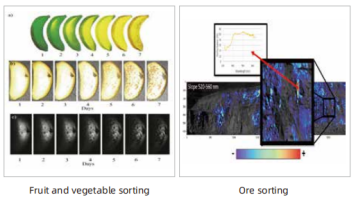
Non-destructive detection of pesticide residues
Visualization of meat freshness and fat/protein distribution
Uniformity and authenticity testing of tablet ingredients
With years of experience in spectral measurement and optical design, CHNSpec has developed hyperspectral and color analysis equipment covering the full spectrum from visible light to short-wave infrared, combining high sensitivity and high stability. This offers food and pharmaceutical companies a complete product chain from laboratory research and development to production line inspection.
V. Selection Guide: How to Choose the Most Suitable Spectral Imaging Technology for You?
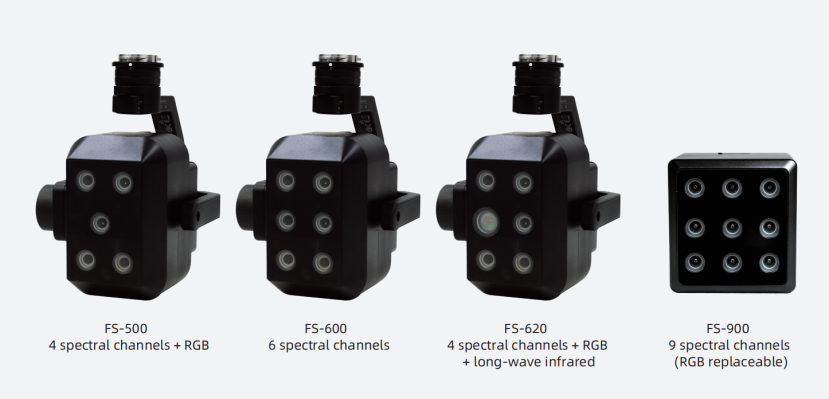
When deciding between hyperspectral and multispectral imaging equipment, it is recommended to refer to the following decision-making process:
Selection Consideration Criteria:
| Confirm whether the target substance is unknown or complex? | Yes → Select hyperspectral imaging. Before specific characteristic wavebands are determined, comprehensive continuous hyperspectral data are required for exploration and modeling. | ||
| No → Confirm: Are there already several clear characteristic wavebands, and are high efficiency and cost-effectiveness prioritized? | Yes → Select multispectral imaging. Use customized optical filters or sensors for designated wavebands to achieve efficient on-line detection at lower cost. | ||
| No → Need to clarify the requirements for real-time performance and hardware deployment | If portable integration, low power consumption and ultra-high-speed processing are required, the multispectral solution is preferred. | ||
| If you pursue ultimate spectral precision, material identification capacity and in-depth research data, hyperspectral imaging is the ideal choice. | |||
VI. Conclusion
Multispectral imaging and hyperspectral imaging are not mutually exclusive, but rather complementary optical detection methods. Multispectral imaging is known for its "high cost-effectiveness and quick response," making it suitable for large-scale applications in specific scenarios. Hyperspectral imaging, on the other hand, is known for its "high resolution and deep analysis," making it a powerful tool for scientific research and high-precision inspections.
When choosing equipment, combining professional brand solutions in the optical detection field, like CHNSpec, can be helpful. You can start by using a hyperspectral system to extract and model spectral features, and then evaluate options for mass production and on-site deployment based on actual needs, to achieve a balance between technical performance and return on investment.


