what is hyperspecral imaging(HSI)
Forward
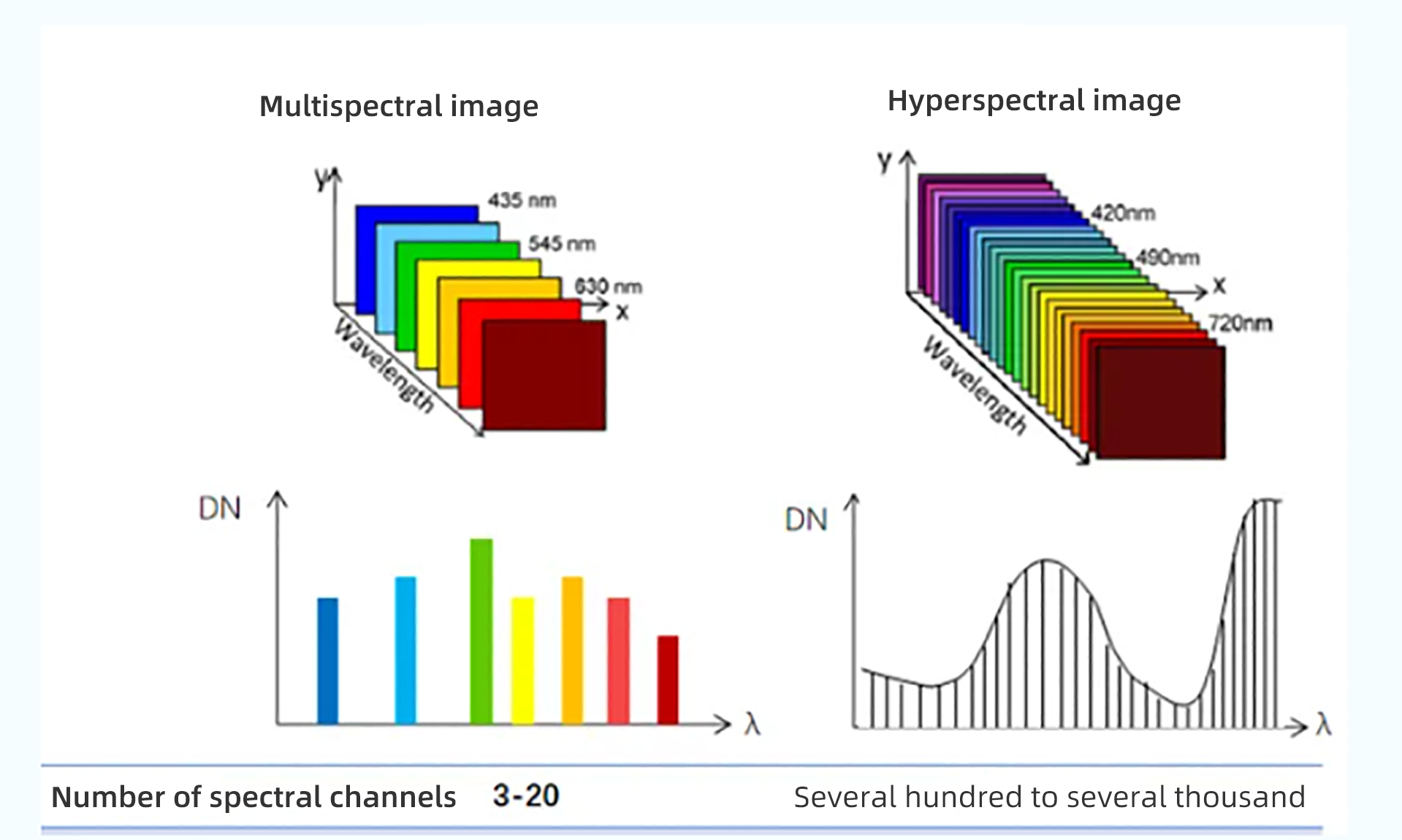
Hyperspectral imaging (HSI) is a spectroscopy-based analytical technique that collects thousands of images of the same spatial region at different wavelengths. While the human eye has only three color receptors, blue, green, and red, HSI measures the continuous spectrum of each pixel in a scene with fine wavelength resolution not only in the visible range, but also in the near-infrared (NIR) range. . The light hitting each pixel is broken down into many different spectral bands to provide more information about what is being imaged. The collected data forms a 3D hyperspectral cube, where two dimensions represent the spatial extent of the scene and the third dimension represents its spectral content.

HSI is commonly referred to as Hyperspectral imaging, which also includes multispectral imaging (MSI). The main difference between these two imaging systems is that HSI uses a continuous range of wavelengths (e.g., 400 to 1000 nm in 5 nm steps), whereas MSI uses a subset of the target wavelengths at selected locations (e.g., 400 to 1000 nm in 100 nm steps).MSI sensors typically have between 3 and 10 different wavelengths measured in each pixel, whereas HSI images MSI sensors typically measure 3 to 10 different bands in each pixel, whereas HSI images can contain hundreds of narrower but continuous spectral bands. As a result, HSI sensors contain much more data than MSI sensors. For example, MSI can be used to map areas of a forest, whereas a hyperspectral image can be used to map tree species within a forest.
Although MSI can be considered a simplified subset of HSI, the two technologies are complementary and the choice between them depends on the application requirements. For example, in the visible channel, MSI can be used to recognize the contours of fruits and find hard-to-see bruises on fruits such as blueberries. But if the aim is to analyze the fat content of avocados in great detail, this can only be done with HSI technology.
The algorithms and image processing methods behind MSI and HSI date back to the 1970s, when Landsat 1 was the first satellite in the U.S. Landsat program and the first to carry a multispectral scanner. NASA's Airborne Imaging Spectrometer (AIS) and AVIRIS followed in the mid-1980s, when the term “hyperspectral imaging” was coined by Jerry Solomon at Caltech.
At that time, microprocessors did not exist and image processing had to be done in large, centralized computer centers. Since then, and especially in the past five years, HSI technology has expanded from Earth observation to many areas such as agriculture, industrial sorting, medical research, food quality control, and the environment, thanks to advances in microprocessing and chip-based sensors. Monitoring.
Hyperspectral applications
Each material has specific spectral characteristics that can be used as a “fingerprint” for its unique identification. As a result, HSI is used in a wide range of applications due to its ability to non-invasively, label-free, and non-destructively identify the composition of substances. They include:
Medical: for augmented reality surgery and medical diagnostics
Machine vision: for classifying virtually any material - from food and minerals to textiles and plastics
Remote sensing: for classifying agricultural soils, minerals, plastics, pollution and monitoring
Agriculture: detecting early symptoms of disease, water stress and soil quality to optimally control growth processes
Art and heritage analysis: to tell the story of how, when and where artifacts were originally made or subsequently altered
Food quality control: identifying and quantifying the chemical composition of food products, providing information on nutrition, fat percentage, sugar content and freshness
Waste Sorting: Sorting and separating hazardous materials such as plastics, textiles, metals, glass, paper, cardboard and asbestos
Pharmaceuticals: for quality assurance of the chemical composition of pharmaceuticals
Mining and petroleum: rapid, reliable mineral analysis of cores and other geological samples
Forensics: collection of evidence from crime scenes, such as blood and gunpowder residues
Commercialization of hyperspectral
According to a recent market report, the global hyperspectral imaging market is expected to grow at a compound annual growth rate (CAGR) of 8.2% between 2020 and 2027 to reach $3.52 billion by 2027. Asia Pacific and Europe are expected to be the fastest growing regions with CAGRs of 9.3% and 8.5%, respectively.
The key drivers are the growing demand for accurate and reliable material analysis, the development of new technologies (e.g., artificial intelligence combined with the development of low-cost imaging systems), and the growing demand for remote sensing applications. The main applications will be for medical diagnostics, industrial machine vision, environmental monitoring and military surveillance.
Types of hyperspectral
Hyperspectral cameras can capture information to form a 3D data cube in five main ways
Whiskbroom (spot scanning) captures one pixel at a time. An image is formed when the camera scans the sample and contains all of its spectral information. Although the image acquisition process is time-consuming, this method results in very high spectral resolution.
Push-scan (line scan) measures continuous spectra, one line of pixels at a time, which is now the most mature and technologically mainstream route to hyperspectral technology. It is widely used in industrial quality control and scientific research remote sensing, etc. The technology is stable and comprehensive, and the products are highly mature.
Fourier Transform (FT) spectroscopy is another method for measuring continuous spectra. This method combines a monochromatic imaging sensor with an interferometer and has a higher luminous flux than push-scan systems, but is only suitable for imaging static scenes.
Spectral scanning collects all the spatial information for a given wavelength, one wavelength at a time. While each image is fast, spectral scanning is slow to generate cubes due to the time required to change wavelengths.
Hyperspectral fast cameras capture hyperspectral video. They typically offer limited spectral and spatial resolution and are more of a multispectral camera, but they are fast and ideal for imaging moving objects.
Of course technology is changing rapidly and there are various new techniques emerging, such as 2D grating, spectral computational imaging, all of which are processed by many post-processing algorithms, and all of which are deficient or limited in one way or another in their current application areas.
 Introduction to Hyperspectral Manufacturers
CHNSpec
Specim
Headwall
resonon
Look ahead
While HSI produces much higher resolution than MSI systems, it has the disadvantage of cost and complexity. Hyperspectral cubes are large, multidimensional data sets, and analyzing hyperspectral data requires fast processing, sensitive detectors, and large data storage capacity. These factors significantly increase the cost and complexity of acquiring and processing hyperspectral data. For example, in space applications, a major problem is how to program hyperspectral satellites to classify data on their own and transmit only important images, as the transmission and storage of large amounts of data can be difficult and costly.
Similarly, for industrial applications, the decision to use local or remote image storage and data output could affect the speed of the application, which had to keep pace with production. Other problem areas include determining the right wavelength, selecting the right camera with the right spectral and spatial resolution, and selecting illumination with sufficient intensity at critical wavelengths. And because HSI often requires a high level of physical understanding, the software needs to be as intuitive as possible and support easy creation of material classifications.
To address these issues, the development of HSI technology to date has shared a common goal: to reduce complexity and make HSI industrial applications easier, faster, and cheaper than ever before.
Over the next few years, as HSI technology becomes less complex and cheaper, it will inevitably move into mainstream imaging applications because it is the only technology with sufficient spectral and spatial resolution to meet the growing demand for accurate and reliable materials analysis. Wide range of industries. Expanding HSI applications into new industries such as agriculture, environmental monitoring, and biomedicine is next. HSI technology is expected to play an important role in these markets as the demand for more accurate materials analysis continues to grow. In addition, the growth of remote sensing and drones is expected to drive the demand for HSI technology in environmental monitoring and mapping applications. As HSI technology continues to evolve, it has the potential to revolutionize the way we understand and analyze materials, providing new insights and opportunities for a wide range of industries.
Hyperspectral technology is a tool that has the potential to have a significant positive impact on our productive lives. Whether it is used to promote sustainable development, improve public health or enhance safety and security, this cutting-edge technology is helping us to see the world in exciting new ways and inspiring us to tackle some of the challenges facing humanity.
How can we Help you?
Email*
Phone*
Name*
Country/Region*
Which Products are you interested in?*


