Which polarimeter is the best? Analyzing the differences in selection needs for pharmaceuticals, food, and chemicals
Polarimeters are utilized across various sectors, including pharmaceuticals, food and sugar production, and fine chemicals—though each industry prioritizes different metrics. While the question "Which polarimeter is best?" is common, the requirements vary: pharmaceutical laboratories prioritize specific rotation and data compliance; the sugar and food industries focus on sugar-degree scales and high-throughput processing; and the fine chemical sector often deals with dark-colored samples and the need for precise temperature control. This article outlines these industry-specific requirements and explains how different instrument configurations align with them.
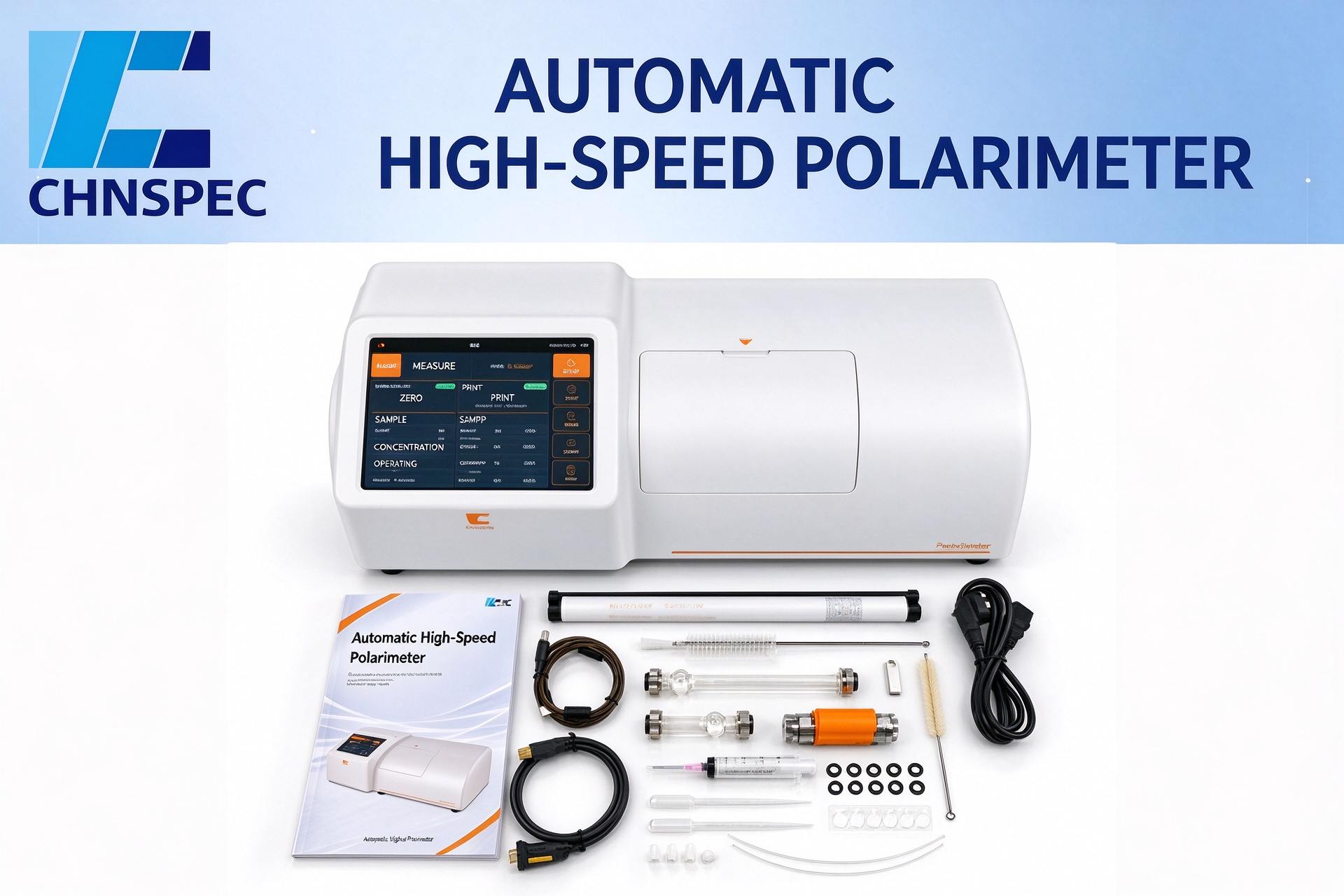
Pharmaceuticals: Specific Rotation, Purity, and Data Compliance
For chiral drugs, active pharmaceutical ingredients (APIs), and injectable products, specific rotation is a key indicator of purity and concentration. Since specific rotation must be measured under strictly defined conditions—including temperature, wavelength, optical path length, and concentration—the results must be documented in a way that ensures they are reviewable and traceable. When selecting an instrument, it is essential to verify that the relative error, resolution, and repeatability meet the relevant methodological standards. Furthermore, laboratories subject to GMP (Good Manufacturing Practice) regulations must evaluate features such as audit trails, hierarchical password management, electronic signatures, and data traceability.
CHNSPEC’s mid-range and high-end polarimeter models offer optional FDA-compliant audit trail software. These systems support four-level password management, accommodate up to 1,000 user accounts, and include electronic signature and data traceability functions, with the capability to integrate into LIMS (Laboratory Information Management Systems). For pharmaceutical applications, these features are critical; they ensure that measurement data can be seamlessly incorporated into quality records, rather than existing merely as an isolated numerical value.
Food and Sugar Production: Sugar-Degree Scales and Throughput
In the sugar industry and food laboratories—where applications include determining sucrose content, detecting adulteration in honey, or analyzing invert sugars in fruit juice—measurements are typically expressed using the sugar-degree (°Z) scale. These environments often involve large volumes of samples processed in concentrated batches, making the speed of obtaining stable readings and the ability to recall saved test methods essential. CHNSPEC polarimeters support a dedicated sugar-degree measurement mode with a range of ±259°Z. With a full-scale response speed of 8° per second—averaging just 26 seconds for six consecutive measurements—these instruments help minimize wait times and the need for repetitive setup when handling large batches of samples. Food sample analysis often requires conversions involving different optical path lengths and concentrations. Instruments that support modes for concentration and specific optical rotation allow for both content screening and sugar content (Brix) determination to be performed on a single device. When selecting an instrument, consider the typical batch size of samples handled in your laboratory, and evaluate whether the instrument’s response speed and method storage capacity are sufficient for your needs.
Fine Chemicals: Adaptability to Dark-Colored Samples and Temperature Control
In the fine chemical industry, samples such as chiral intermediates, dyes, and fragrances are often dark in color. Pigments and syrups can absorb significant amounts of light, reducing the intensity of light reaching the detector. For such applications, it is essential to consider the instrument's lower limit for sample transmittance: 0.05% for entry-level models, 0.03% for mid-range models, and 0.01% for high-end models. A lower transmittance limit provides greater capability for analyzing dark, low-transmittance samples.
Furthermore, optical rotation is temperature-sensitive; fluctuations in temperature can alter both the molecular optical rotation and the density of the solution. Precise measurements therefore require constant temperature control. Mid-range and high-end models offer temperature control between 10°C and 60°C with an accuracy of ±0.1°C, a display range of -20°C to 120°C, and include a 100mm temperature-controlled sample tube. For samples such as reaction intermediates—which require specific temperature conditions—the stability of temperature control directly determines whether results can be compared consistently across different batches.
Matching the Three Tiers of Configuration
Applications for the Entry-Level DS-P500 Polarimeter
The entry-level model features a reading resolution of 0.001°, a relative error of ≤0.004°, and a repeatability of ≤0.002°. It is well-suited for laboratories that primarily handle light-colored samples with less stringent temperature requirements, focusing on routine screening or educational purposes. It can also be used for daily content determination tasks that require moderate levels of precision. Application Scenarios for the Mid-Range DS-P700T Polarimeter
The mid-range model features a reading resolution of 0.0001°, a relative error of ≤0.003°, and a zero-point repeatability of 0.0005°. Equipped with temperature control, it is well-suited for routine pharmaceutical testing and chemical sample analysis requiring constant-temperature measurement. It is also capable of handling batch sugar content (Brix) testing and offers options for compliance-ready software.
Application Scenarios for the High-End DS-P900T Polarimeter
The high-end model offers a zero-point repeatability of 0.0004° and can measure samples with a transmittance as low as 0.01%. It is designed for dark, low-transmittance samples and high-precision measurements requiring superior angular resolution—such as the analysis of dark-colored pharmaceutical solutions, high-concentration syrups, and complex chiral intermediates.
Preparing a Sample Inventory Before Selection
Before selecting an instrument, it is advisable to compile a list of your routine samples, including their type, color, concentration range, required measurement modes (e.g., specific rotation, concentration, or sugar content), batch volume, and regulatory compliance requirements. You can then compare these against the specifications and features of potential instruments. Since different industries evaluate the same instrument from different perspectives, aligning the device with your specific operational needs is far more meaningful than simply comparing raw technical parameters. The three-tier configuration—entry-level, mid-range, and high-end—is designed to provide flexibility regarding precision, temperature control, the ability to handle dark samples, and regulatory compliance capabilities.
CHNSpec Technology’s (CHNSpec) fully automatic, high-speed polarimeters are categorized into entry-level, mid-range, and high-end models. These cover the common requirements of the pharmaceutical, food/sugar, and fine chemical industries and can serve as a useful reference for your selection process. We recommend testing the instruments with your own representative samples and consulting the manufacturer for detailed pricing and configuration options.


How can we Help you?
Email*
Phone*
Name*
Country/Region*
Which Products are you interested in?*
Verification code