What Is a Polarimeter? An Easy Guide to Its Working Principle & Application Fields
In laboratories in the pharmaceutical, food, sugar, and chemical industries, polarimeters are commonly used optical analysis instruments.
They don't require complex chemical reactions and can measure a sample's optical rotation through optical methods. By combining relevant parameters, they can calculate specific rotation, concentration, and other indicators, providing data references for product quality control, raw material testing, and scientific research.
So, what exactly is a polarimeter? How does it work? And where can it be applied? Let's take a look today.
1. What is a polarimeter?
A polarimeter is an optical analysis instrument that measures the optical rotation properties of substances. It is mainly used to determine the angle of rotation that optically active substances produce on polarized light.
Common substances in daily life like sucrose, glucose, fructose, as well as some drugs and organic compounds, are optically active.
When plane-polarized light passes through these substances, its polarization direction rotates by a certain angle, which is called the optical rotation.
By measuring the optical rotation, and considering sample concentration, path length, and relevant standard methods, you can further analyze the properties of the substance.
2. How does a polarimeter work?
The measurement principle of a polarimeter is mainly based on the optical rotation phenomenon of substances.
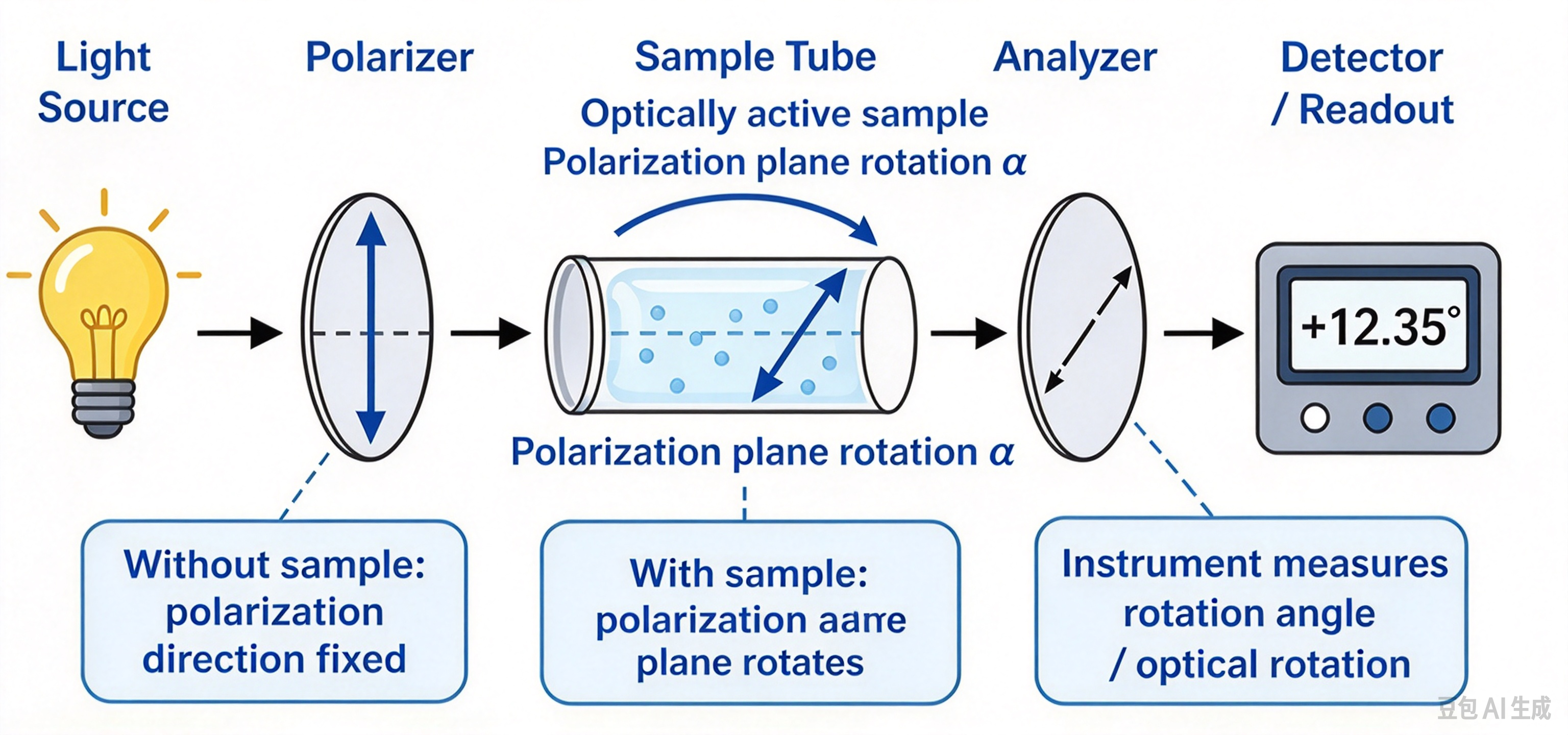
In simple terms, the process can be divided into the following steps:
(1) Generating polarized light
The instrument forms plane-polarized light with a specific vibration direction through a light source and a polarization optical system.
(2) Light passing through the sample
The solution to be measured is placed in a polarimeter tube. When the polarized light passes through the optically active sample, its polarization direction rotates.
(3) Detecting the rotation angle
The instrument uses an optical detection system to identify changes in the polarization direction and calculate the optical rotation.
(4) Outputting the measurement results
Depending on the selected measurement method, the instrument displays the optical rotation or results such as specific rotation and concentration.
Optical rotation is affected by the type of substance, sample concentration, path length, temperature, and measurement wavelength. Therefore, in actual testing, it is necessary to control measurement conditions according to the relevant standards.
3. What indicators can a polarimeter measure?
A polarimeter can not only measure optical rotation, but also, depending on different testing needs, offer a variety of measurement modes.
- Optical rotation
This shows the angle by which polarized light rotates after passing through a sample, measured in degrees (°), and is the basic measurement parameter of a polarimeter.
- Specific rotation
Under specified conditions like temperature and wavelength, this parameter is calculated based on optical rotation, path length, and concentration. It is commonly used for identifying optically active substances and quality control.
- Concentration
For substances with a known specific rotation, the concentration of a solution can be calculated from optical rotation when appropriate measurement conditions are met.
- International sugar content
A special scale used for sugar optical analysis, it is practically useful for raw material analysis and quality testing in the sugar industry. It’s important to note that international sugar content is not the same as the commonly known Brix scale.
4. Which industries mainly use polarimeters?
Polarimeters are widely used and can play a role in laboratory testing across several industries.
(1) Pharmaceutical industry: drug quality control
Some drugs and their raw materials are optically active. Measuring specific rotation provides a reference for raw material identification, quality inspection, and batch consistency analysis.
For drugs with specific rotation requirements in pharmacopeias, it is necessary to control measurement temperature, wavelength, and concentration according to the specified method.
(2) Food and sugar industry: sugar analysis
Sucrose, glucose, fructose, and other substances have different optical characteristics.
Polarimeters can be used for measuring sugar solution rotation, sugar product analysis, and quality testing of some food raw materials, providing data support for production process control.
(3) Fine chemical industry: detection of optically active substances
In the analysis of flavors, fine chemicals, and some organic compounds, optical rotation and specific rotation can serve as reference indicators for substance characterization and quality control.
(4) Universities and research institutions: teaching and research
Polarimeters can be used to demonstrate optical rotation, study material properties, and conduct related analysis experiments, helping researchers understand the optical characteristics of substances.


Pharmaceutical Industry/Fine Chemical Industry/Food Industry


Cosmetics & Daily Chemicals/Materials Science/Universities and Research Institutes
5. What should be paid attention to when measuring with a polarimeter?
To get stable and reliable results, besides the performance of the instrument itself, you should also pay attention to the following aspects:
Measurement temperature: The optical rotation of some substances changes with temperature, so samples should be controlled according to standard requirements during testing.
Polarimeter tube length: The path length of the tube affects the optical rotation. For suitable samples, a longer tube can increase the measured rotation angle, but you also need to consider the sample's light transmittance.
Sample condition: Bubbles, suspended particles, and other impurities in the solution can affect optical measurement, so samples should be handled according to the testing method.
Measurement wavelength: Optical rotation may differ at different wavelengths, so you should use the working wavelength consistent with the testing method.
6. CHNSpec Technology DS-P900T Series Fully Automatic High-Speed Polarimeter
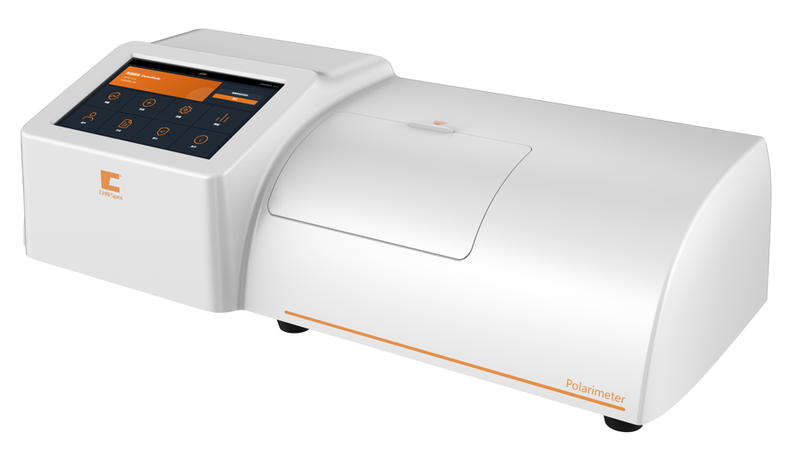
To meet laboratory polarimetric analysis needs, CHNSpec Technology has launched the DS-P500, DS-P700T, and DS-P900T fully automatic high-speed polarimeters, suitable for pharmaceutical, food, sugar, chemical, and scientific testing scenarios.
The series uses 589nm sodium D light with 0.01-level accuracy and offers measurement modes including optical rotation, specific rotation, concentration, international sugar scale, and user-defined modes.
The instruments come with a 10.1-inch IPS touchscreen, supporting data viewing and method management. The DS-P700T and DS-P900T also support 10–60°C temperature control with ±0.1°C accuracy, suitable for lab scenarios with temperature requirements.
Depending on your application needs, you can choose the right model based on sample light transmittance, temperature control requirements, data management needs, and testing standards.


How can we Help you?
Email*
Phone*
Name*
Country/Region*
Which Products are you interested in?*
Verification code