What aspects should you pay attention to when choosing a polarimeter for a research university lab?
Usage Scenarios of Polarimeters in Universities and Research Institutes
In university and research institute laboratories, polarimeters are mostly used for research topics related to chemistry, pharmacy, and food science. In organic synthesis experiments, after synthesizing chiral products, the optical rotation needs to be measured to calculate the specific rotation, which is used to evaluate the synthesized products. In natural product research, chiral compounds isolated from plants use optical rotation data as one of the basic characterization parameters. Some teaching lab courses also use polarimeters for basic physical and chemical demonstrations.
Samples in research labs are very diverse, and different projects require testing very different kinds of samples. There are clear synthetic product solutions as well as crude extracts that are deeply colored and of limited purity. Some projects require extensive repeated testing, while others have few samples but demand high accuracy. The instruments need to handle both large-scale testing and small-sample high-precision characterization. At the same time, research equipment is often shared among multiple people, with members of different project groups taking turns operating the instruments.
Common Issues When Choosing a Polarimeter for Research Labs
When multiple people share the instrument, there's often no account management, making it impossible to distinguish test records from different users. This makes it hard to trace experimental data later and figure out which researcher performed the test. The samples can vary widely, and some rough extracts are low in transparency, making it difficult for ordinary instruments to measure stably.
Research work often requires custom calculation formulas, and the standard optical rotation or specific rotation modes may not meet the project needs, so the instrument needs to support custom parameter settings. Some instruments have limited storage capacity, so after accumulating a lot of experimental data, there's not enough space, requiring frequent copying and exporting. Few interfaces on the instrument make it inconvenient to connect with computers or lab information systems.
Some research groups have limited budgets and need to balance performance with cost. It's important to distinguish essential functions from optional ones to avoid overbuying features or getting a device that doesn’t meet project requirements.
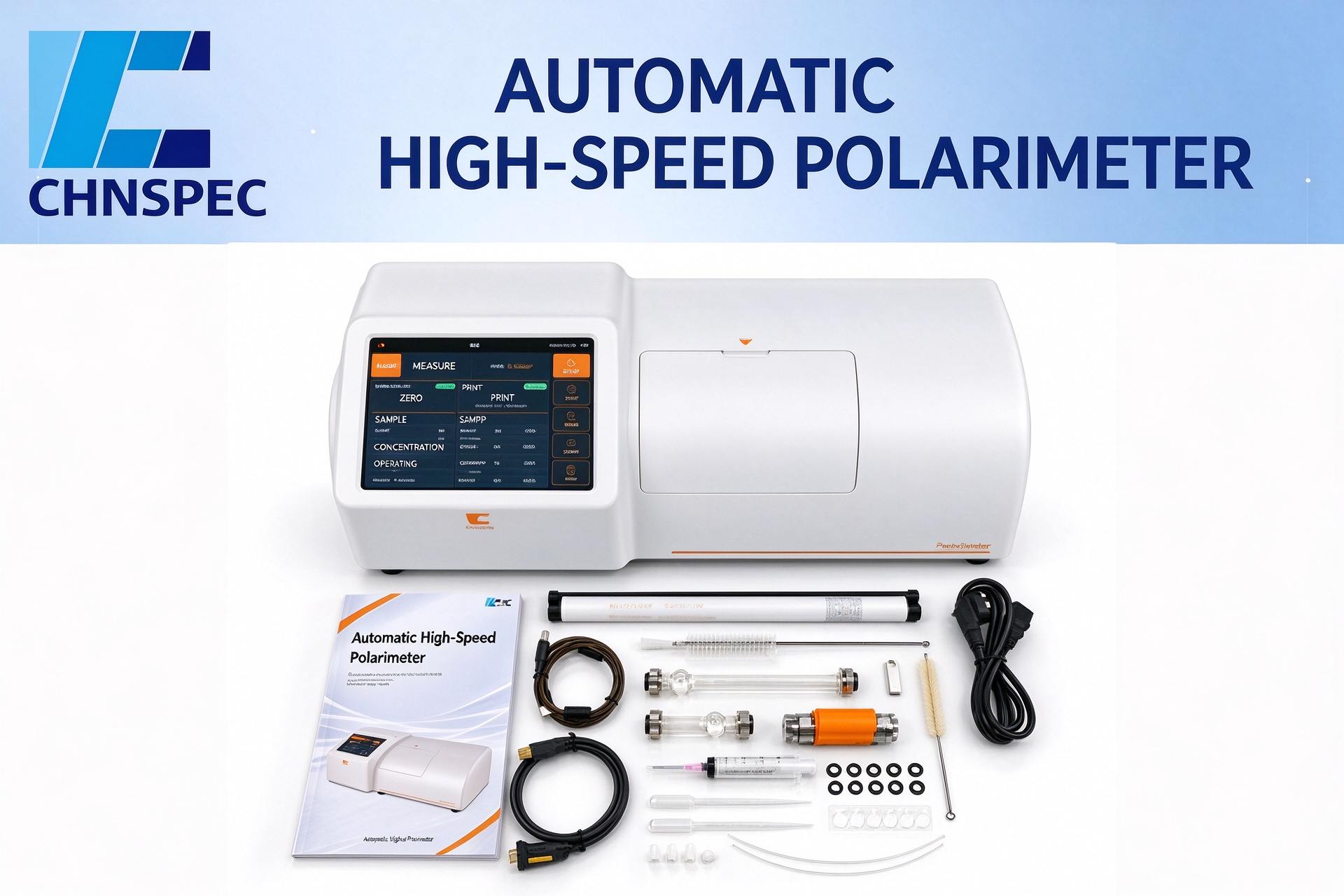
CHNSpec Fully Automated High-Speed Polarimeter Configurations for Research Scenarios
The CHNSpec Technology DS-P900T series fully automated high-speed polarimeter comes in three configurations, making it easier for research groups with different budgets to choose. All versions come with customizable measurement modes, so researchers can set calculation logic based on their project needs and directly output target results. The device has 128GB of storage, supporting a large amount of experimental data, and features RS232, dual USB, and WiFi interfaces for easy data exchanges with computers and lab systems.
The mid-range and high-end versions have 4-level password management and can store a large number of user accounts. When multiple people share the instrument, it can distinguish between users and track their operations. Multi-point automatic calibration is also suitable for labs with frequent personnel changes, lowering the calibration barrier. The device’s fast testing response can shorten the time for repeated measurements when handling batches of synthetic samples.
If the project mainly involves teaching demonstrations or testing light-colored synthetic samples, the entry-level version can meet basic needs. For frequent testing of dark rough extracts with multiple users needing account management, the mid-range model is the preferred choice. When purchasing instruments for research labs, it’s important to understand your sample characteristics, whether transparency or temperature control is needed, and the permission requirements for multiple users, serving as a key reference for selection.


How can we Help you?
Email*
Phone*
Name*
Country/Region*
Which Products are you interested in?*
Verification code