ASTM D1003 Standard Tests for Haze and Transmittance
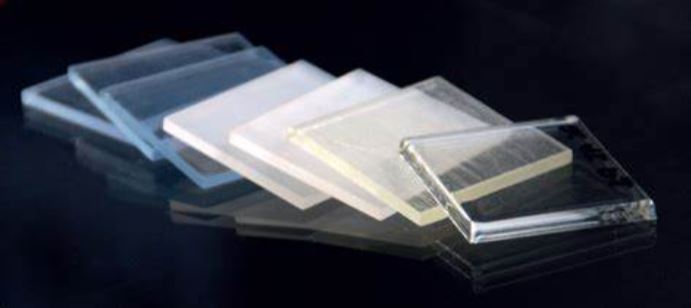 ASTM D1003 Standard Test for Haze and Light Transmission of Transparent Plastics
Haze is the effect of diffuse transmission of light through a transparent material, resulting in poor visibility and/or glare. Evaluating this effect is called haze for solids and turbidity for liquids.
Haze may be material-specific, the result of a molding process, or the result of surface texture; it may also be the result of environmental factors such as weather conditions or surface abrasion. Transmittance evaluates the amount of light passing through a sample. Therefore, haze and transmittance measurements can be used for product development, process development and end-use performance testing. Transmittance and haze are correlated, but not necessarily so; diffuse transmittance manifests itself in the form of a hazy or smoky haze caused by the scattering of light as it passes through a film or sheet of material when viewing an object through the material; or in the form of a hood glare that appears on the windshield of an automobile while driving in the sun.
While haze measurements are most commonly made with a haze meter, a spectrophotometer can also be used as long as it meets standard geometric and spectral requirements. Measuring the haze of plastics using a spectrophotometer can provide valuable diagnostic data on the source of the haze.
There are two protocols for measuring haze under ASTM D1003, with Protocol A (Haze Meter Method) test values typically being slightly higher and less variable than Protocol B (Spectrophotometer Method) test values.
For transparent samples placed some distance from the integrating sphere inlet, the direct light transmission of the sample can be measured. However, when the sample is turbid, the total transmittance should be measured by placing the sample to the side of the integrating sphere. The measured total transmittance will be greater than the regular transmittance, depending on the optical properties of the sample.
To measure haze, a second test method must be used, i.e., the sample should always be placed close to the integrating sphere to obtain both haze and total transmittance.
Care should be taken that the sample under test avoids heterogeneous surfaces or internal defects that are not characteristic of the material, so that haze data representative of the material can be obtained. Prior to conducting the test, the characteristics of the material under test should be considered, and specimen preparation, conditioning, dimensions of the material, or temperature and humidity of the test specimen should be pre-specified to ensure that the data are reproducible.The ASTM D1003 test method is not equivalent to the methods of ISO 13468-1 and ISO/DIS 14782.
The ASTM D1003 test method is primarily concerned with evaluating certain light transmission and wide-angle light scattering properties of planar portions of transparent materials (e.g., transparent plastics). Two protocols are provided for light transmission and haze measurements. Protocol A uses the haze meter method and Protocol B the spectrophotometer method. Materials with haze values greater than 30% are considered diffuse materials and are not suitable for this method and need to be tested by the method of ASTM E2387.
CHNSpec Collection Related Standards
ISO related standards
ISO 13468-1 Measurement of total light transmittance of plastics and transparent materials
ISO/DIS 14782 Measurement of fog of plastics and transparent materials
ASTM Standards
ASTM D618 Test Practice for Plastics
ASTM D883 Plastics Terminology
ASTM D1044 Standard Test for Surface Abrasion Resistance of Transparent Plastics
ASTM E259 Practice for Preparing Standards for Transferring White Reflection Coefficients of Pressed Powder in Hemispherical and Bidirectional Geometries
ASTM E284 Appearance Terminology
ASTM E691 Practice for Conducting Interlaboratory Studies to Determine the Accuracy of Test Methods
ASTM E2387 Standard Practice for Goniometric Optical Scattering Measurements
ASTM E2935 Practice for Conducting Equivalency Tests to Compare Test Procedures


How can we Help you?
Email*
Phone*
Name*
Country/Region*
Which Products are you interested in?*
Verification code